
How to Choose the Right Fishing Line for Drone Fishing
Drone fishing puts unique demands on your line — long runs, heavy rigs, and fish that take 400 yards in seconds. Here's exactly what to use, what to avoid, and why it matters more than most anglers realize.

Most anglers spend hours researching drones, rigs, and bait — and then grab whatever line is on the shelf without much thought. That's a mistake. Drone fishing creates a specific set of demands on your line that normal surf fishing doesn't: you're running out 300–500 yards during the drop, dealing with the drone's pull on the spool, and potentially fighting large fish on a very long line with significant bow.
The wrong line choice leads to tangles during the drone run, lost fish on the fight, or a snapped line when a shark runs hard. The right choice makes all of that invisible. Here's what to use.
Not sure what else your drone fishing setup needs? → The complete accessories guide — what every fishing drone should come with.Why drone fishing is different for line
In standard surf casting, you load the line with a cast — a brief, high-energy event. In drone fishing, the line pays out slowly over 1–2 minutes as the drone flies out. That slow, continuous pull creates different friction on the guides, different coiling behavior off the spool, and different tension dynamics than a conventional cast.
There's also the fight. A fish hooked at 400 yards has significantly more line in the water than one hooked at 80 yards from a cast. More line means more stretch (with mono), more bow (with braid), and more surface area for the line to catch current and wind. All of this affects how you feel the fish and how much control you have.

Braided line on a drone fishing setup — thin diameter, zero stretch, smooth pay-out under the drone's pull.
The three line types — and how they perform
Braid is the standard choice for drone fishing and for good reason. Its thin diameter means more line on the spool — critical when a large shark or tarpon decides to run 400 yards in one burst. Zero stretch gives you direct feel of the fish at long range, where mono's elasticity becomes a serious problem. And its smooth surface pays out cleanly under the drone's steady pull without the memory coiling issues that mono develops.
The main consideration with braid is visibility and abrasion. Always use a mono or fluorocarbon leader between the braid and your rig — this handles the abrasion near the hook, provides some shock absorption on the strike, and keeps the braid away from sharp structure near the bottom.
Mono is workable for light drone fishing — small species, short drops, calm conditions. Its stretch acts as a natural shock absorber on lighter tackle, which can be an advantage with smaller fish. But for serious drone fishing, mono's limitations become problems fast: it has significant memory coiling that causes tangles during the slow drone pay-out, its thicker diameter reduces spool capacity, and at long range its stretch makes it hard to feel or set hooks effectively.
If you're just getting started with drone fishing and only have mono on your current setup, it'll work for your first sessions. But upgrade to braid before targeting larger species.
Fluorocarbon has excellent abrasion resistance and near-invisibility underwater — both useful properties. But as a main line for drone fishing, it's expensive, has significant memory, and is stiffer than braid at equivalent breaking strengths. Use fluorocarbon where it excels: as a leader material between your braid and your rig. A 4–6 ft fluorocarbon leader gives you abrasion resistance near the bottom and reduces visibility near the hook without the drawbacks of running it on the main spool.

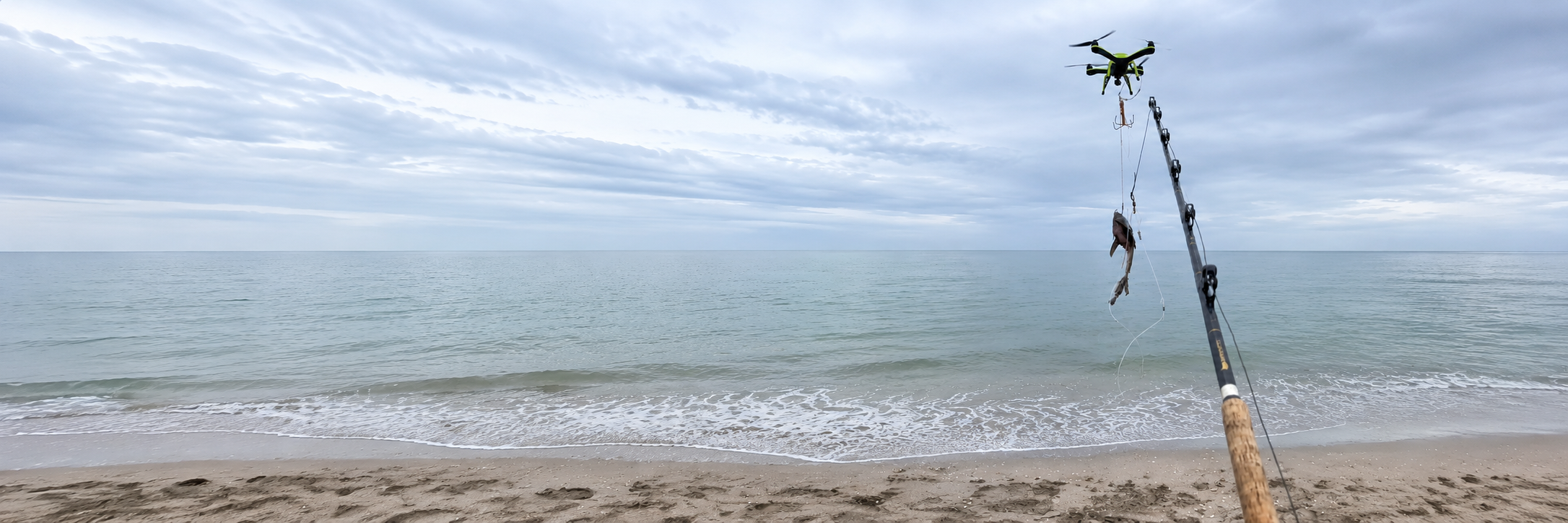
The drone pulling line from the spool during the drop — braid's thin diameter and zero memory keeps the pay-out smooth and tangle-free.
Line setup by target species
| Target species | Main line | Leader | Notes |
|---|---|---|---|
| Shark (blacktip, spinner) | 65 lb braid | 200 lb mono + wire | Wire leader essential — sharks bite through mono |
| Shark (bull, hammerhead) | 80 lb braid | 200 lb mono + wire | Heavier braid for longer, harder runs |
| Tarpon | 65 lb braid | 80 lb fluoro, 6 ft | No wire — tarpon are leader-shy |
| Cobia | 50 lb braid | 60 lb fluoro, 4 ft | Light leader for better presentation |
| Pompano / drum | 30–40 lb braid | 30 lb mono, 3 ft | Lighter setup for smaller species |
| Carp (freshwater) | 30 lb braid | 15 lb fluoro, 18 in | Short, light fluoro hooklink |
How much line do you need on the spool?
For drone fishing, 300 yards is the practical minimum. The drone run itself can use 400–500 yards depending on how far offshore you fly. Add to that the distance a large fish can run before you turn it, and a lightly spooled reel becomes a real problem.
With 65 lb braid at 0.35mm diameter, a standard surf reel holds 400–500 yards comfortably. That covers the drone run and gives you enough reserve for a long fight. Spool up completely before your first session — don't fish a half-empty reel on a drone drop.

The right line setup makes the fight manageable — even at 300+ yards of braid in the water.
Reel recommendations for drone fishing
The line is only as good as the reel it's on. For drone fishing specifically, look for a reel with a smooth, reliable freespool — this is more important than raw drag power. The freespool needs to run completely freely under the drone's pull without any hesitation or sticking.
Conventional (baitcasting) surf reels are the most popular choice for drone fishing because their large capacity and smooth lever drag make freespool management straightforward. A spinning reel works too, but requires opening the bail before the drone takes off — easy to forget under the pressure of managing the flight.
Frequently asked questions
What fishing line is best for drone fishing?
65–80 lb braided line is the standard choice for drone fishing. Its thin diameter maximizes spool capacity, zero stretch gives you direct feel at long range, and smooth pay-out prevents tangles during the drone run. Always pair it with a mono or fluorocarbon leader.
Can I use monofilament for drone fishing?
You can use mono for light drone fishing and smaller species. However, its memory coiling can cause tangles during the slow drone pay-out, its stretch reduces sensitivity at long range, and its thicker diameter limits spool capacity. Braid is the better choice for serious drone fishing.
How much line do I need for drone fishing?
300 yards minimum, 400–500 yards recommended. The drone run can use 300–500 yards depending on how far offshore you fly, and you need enough reserve for a long fight with large fish. Spool completely before your first session.
Do I need a leader for drone fishing?
Yes. Always use a leader between your braid and your rig — typically 200 lb monofilament for shark fishing, or fluorocarbon for other species. The leader handles abrasion near the bottom and provides shock absorption on the strike.
Why does my line tangle when the drone flies out?
The most common causes are: reel not in full freespool, line with too much memory (common with old mono), spool too lightly loaded, or flying the drone too fast so the line can't pay out smoothly. Switch to fresh braid and confirm freespool before every drop.
The drone that works with
any line setup.
Free shipping across the US in 1–4 days. 30-day money-back guarantee.
SHOP THE XPECE ONE →